
 Aimer Saint Joseph
La joie du Seigneur est votre rempart

Donc, et vous, que garderiez-vous de lui?
Peut-être étiez-vous sur les Champs-Elysées, comme une de mes amies qui a reçu toute une série de bénédictions. Vous garderez alors cette joie particulière qui a sidéré les médias? Le pape Léon est bien une image du prophète Néhémie : la joie du Seigneur est votre rempart (Néhémie, 8, 10). C'est le prophète Néhémie qui a eu cette phrase souvent sortie de son contexte. Mais le pape Léon l'a remise, justement, en contexte, dans son encyclique sur l'IA et dans son voyage parisien.
Léon = Néhémie? La mentalité du bâtisseur
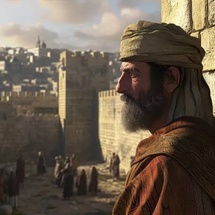
Le livre de Néhémie, quant à lui, s’ouvre sur un moment de grande vulnérabilité dans l’histoire de l’antique Israël. Après l’exil babylonien, une partie du peuple est revenue à Jérusalem, mais la ville est encore en ruines, les murs se sont effondrés et les portes ont été brûlées (cf. Ne 1-2). Néhémie, un juif au service du roi perse Artaxerxès, apprend l’état désastreux de la ville de ses pères. Avant d’agir, il jeûne, prie, intercède pour le peuple ; puis il demande au roi la permission de retourner à Jérusalem et, une fois sur place, il examine en silence les lieux détruits. Il n’impose pas de solutions venues d’en haut. Il convoque les familles, confie à chacune un tronçon de mur à reconstruire, écoute les craintes, coordonne les efforts, fait face aux oppositions. Le récit montre comment la ville renaît non pas grâce à l’initiative d’une seule personne, mais grâce à la responsabilité partagée de tout le peuple : prêtres, artisans, chefs de famille, femmes et jeunes. C’est une œuvre qui a Dieu au centre et qui rétablit les liens avant même de poser les pierres. L’ancienne Jérusalem retrouve ainsi un langage commun, non pas celui de l’uniformité, mais celui de la communion : l’harmonie naît lorsque chacun assume son rôle et que tout le peuple reconnaît sa force comme venant du Seigneur.
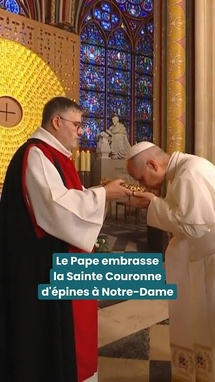
La joie du Seigneur est votre rempart! C'est d'abord cette joie qu'il faut reconstruire. le pape Léon s'y emploie, et il n'est pas le seul. Tout un peuple se lève avec lui, qui refuse de se laisser voler ses remparts et sa joie.. C'est pourquoi le moment où le pape Léon embrasse la Couronne d'épine à Notre Dame de Paris prend toute sa profondeur pour qui sait voir, dans un lieu magnifiquement reconstruit!
Alors, pape Léon, revenez-nous vite sur pied!

Je pris la décision d’admonester notables et magistrats ; je leur dis : « Quel est ce fardeau que vous faites peser sur vos frères ? » Et je convoquai contre eux une grande assemblée.
08 Je leur dis : « Nous avons, dans la mesure de nos moyens, racheté nos frères juifs vendus aux nations. Mais vous, vous vendez vos frères, et c’est à nous qu’ils sont vendus ! » Ils gardèrent le silence et ne trouvèrent rien à répliquer.
09 Je poursuivis : « Ce que vous faites là n’est pas bien. Ne devez-vous pas marcher dans la crainte de notre Dieu, pour éviter l’insulte des nations, nos ennemis ?
10 Moi aussi, mes frères et mes serviteurs, nous leur avons prêté de l’argent et du froment. Eh bien ! remettons-leur cette dette.
11 Rendez-leur immédiatement leurs champs, leurs vignes, leurs oliviers et leurs maisons, et remettez-leur ce qu’ils vous doivent en argent, froment, vin nouveau et huile fraîche que vous leur avez prêtés. »
12 Ils répondirent : « Nous le rendrons, et nous n’exigerons plus rien d’eux ; nous agirons comme tu l’as dit. » Je convoquai les prêtres et je leur fis jurer d’agir selon cette parole.
13 Alors je secouai le pli de mon vêtement, en disant : « Que Dieu secoue de la sorte, hors de sa maison et de ses biens, quiconque ne tiendra pas cette parole : qu’il soit ainsi secoué et dépouillé ! » Toute l’assemblée répondit : « Amen ! » et loua le Seigneur. Et le peuple agit selon ce qui avait été dit.
La clé de la reconstruction : la justice qui crée la joie
Mais Néhémie, s'appuyant sur sa mentalité de bâtisseur, a placé la justice comme fondation des remparts. C'est cela le contexte puissant de cette petite phrase :
Esdras lisait un passage dans le livre de la loi de Dieu, puis les lévites traduisaient, donnaient le sens, et l’on pouvait comprendre.
09 Néhémie le gouverneur, Esdras qui était prêtre et scribe, et les lévites qui donnaient les explications, dirent à tout le peuple : « Ce jour est consacré au Seigneur votre Dieu ! Ne prenez pas le deuil, ne pleurez pas ! » Car ils pleuraient tous en entendant les paroles de la Loi.
10 Esdras leur dit encore : « Allez, mangez des viandes savoureuses, buvez des boissons aromatisées, et envoyez une part à celui qui n’a rien de prêt. Car ce jour est consacré à notre Dieu ! Ne vous affligez pas : la joie du Seigneur est votre rempart ! »
AC
English version
The joy of the Lord is your strength
We have been told of Pope Leo’s forthcoming operation. As a true disaster freak, I thought to myself: what if he were to die now – what would I have left of him? Some popes have died very quickly, such as Saint John Paul I. Rest assured, the Pope’s death is not my subject here, but rather his influence and the life he has already brought.
So, what would you keep of him?
Perhaps you were on the Champs-Élysées, like one of my friends who received a whole series of blessings. Would you then hold on to that special joy which stunned the media? Pope Leo is indeed a living image of the prophet Nehemiah: ‘The joy of the Lord is your strength’ (Nehemiah 8:10). It was the prophet Nehemiah who spoke these words, which are often quoted out of context. But Pope Leo has, quite rightly, put it back into context, both in his encyclical on AI and during his visit to Paris.
Leo = Nehemiah? The mindset of a builder
I have read the encyclical Magnifica Humanitas carefully. It particularly resonated with me when Pope Leo quotes the prophet Nehemiah. As it happens, a friend of mine has written an entire book about this prophet, and I had just bought that book a few months earlier. Pope Leo holds up the Book of Nehemiah as a model of reconstruction for the Church and the world. He draws on Nehemiah’s builder’s mindset. Here is what he says in paragraph 8 of the encyclical : The Book of Nehemiah, in turn, opens at a time of great vulnerability in the history of ancient Israel. After the Babylonian exile, a portion of the people returned to Jerusalem, but the city was still in ruins, the walls collapsed and the gates burned (cf. Neh 1–2). Nehemiah, a Jew in the service of the Persian King Artaxerxes, received news of the disastrous state of his ancestral city. Before taking action, he fasted, prayed and interceded for the people. He then asked the king for permission to return to Jerusalem and, upon arriving, examined the destroyed areas in silence. He did not impose solutions from above. He convened the families, assigned each of them a section of the wall to rebuild, listened to their concerns, coordinated their efforts and addressed any opposition. The narrative shows how the city is reborn, not through the initiative of one man, but through the shared responsibility of all: men, women, priests, artisans, heads of households and young people all play a part. It is an undertaking with God at the center, which rebuilds relationships before rebuilding with stones. Thus, ancient Jerusalem rediscovers a common language — not one of uniformity, but one of communion, namely the harmony that arises when all persons assume their own role and recognize that their strength comes from the Lord.
The joy of the Lord is your fortress! It is this joy, first and foremost, that must be rebuilt. Pope Leo is set about doing just that, and he is not working alone. An entire people is rising up with him, refusing to let their ramparts and their joy be stolen from them. That is why the moment when Pope Leo embraces the Crown of Thorns at Notre-Dame de Paris takes on its full significance for those who know how to see, in a magnificently rebuilt place!
So, Pope Leo, recover quickly!
As I pray for Pope Leo’s health, I pray for his prophetic role in the footsteps of Nehemiah: the prophet Nehemiah had to face many obstacles and acts of intimidation, which are described in detail in the Bible. And surely, Pope Leo must be facing similar challenges too. One episode in Nehemiah’s story provides us with the key to reconstruction, as well as to joy, and to ensuring that this joy does not crumble. This is the episode in chapter 5 where some Jews oppress other Jews, creating dissension and a legitimate revolt. Nehemiah then acts as a model prophet:
“As far as possible, we have bought back our fellow Jews who were sold to the Gentiles. Now you are selling your own people, only for them to be sold back to us!” They kept quiet, because they could find nothing to say.
9 So I continued, “What you are doing is not right. Shouldn’t you walk in the fear of our God to avoid the reproach of our Gentile enemies? 10 I and my brothers and my men are also lending the people money and grain. But let us stop charging interest! 11 Give back to them immediately their fields, vineyards, olive groves and houses, and also the interest you are charging them—one percent of the money, grain, new wine and olive oil.”
12 “We will give it back,” they said. “And we will not demand anything more from them. We will do as you say.”
Then I summoned the priests and made the nobles and officials take an oath to do what they had promised. 13 I also shook out the folds of my robe and said, “In this way may God shake out of their house and possessions anyone who does not keep this promise. So may such a person be shaken out and emptied!”
At this the whole assembly said, “Amen,” and praised the Lord. And the people did as they had promised.
The key to reconstruction: justice that brings joy!
So, while our Pope may be dealing with troublemakers within the Church, working to build peace with the help of the saints and the faithful, let us firmly hold on to the key to reconstruction: the joy of the Lord is our stronghold. But only if we follow Nehemiah’s example and set to work whilst rejecting injustice. If Nehemiah had allowed injustices to persist amongst the Jewish people, joy would have crumbled.
But Nehemiah, leaning on his builder’s mindset, laid justice as the foundation of the ramparts. This is the powerful context of this short sentence:
Then Nehemiah the governor, Ezra the priest and teacher of the Law, and the Levites who were instructing the people said to them all, “This day is holy to the Lord your God. Do not mourn or weep.” For all the people had been weeping as they listened to the words of the Law.
10 Nehemiah said, “Go and enjoy choice food and sweet drinks, and send some to those who have nothing prepared. This day is holy to our Lord. Do not grieve, for the joy of the Lord is your stronghold.”
AC
 Marie Mère de l'Eglise, le pape Léon XIV et le cardinal Newman